As part of the exploration that Marek Pawlowski and I have been conducting around the user experience at the intersection between consumption and creation, we looked at how various services handled the transition. This is part of a series of articles that we are publishing here and at www.mobileuserexperience.com.
The iOS Photos app now delivers a more fluid UX for photo editing. The editing functionality in the app itself is quite powerful and will fully meet most users' requirements. For those, like me at times, who want more tools or are used to tools available in desktop software, iOS now enables easy access to the editing functionality of third party apps. For example, I use ProCam. What is particularly striking here is that the app functionality appears to load directly in the Photos app.
1. Tapping on a photo within the Photos app brings up the top and bottom frame elements, which show where the picture was taken and options for returning to an album, editing, sharing (actually quite a bit more than that), marking as favourite or deleting.
2. Tapping on Edit loads the editing interface. In the bottom left is an icon, a circle with an ellipsis within it.
3. Tapping on the icon brings up a menu of apps that have access to the Photos app for editing. Tapping More will reveal further app options that can be switched on to appear in the menu. I have other photo-editing apps, like Lenca and Hipstamatic, but they don't have access to the Photos app.
4. I then simply tap on the ProCam icon and the ProCam editing interface loads immediately - no switching between apps. There is some loss of functionality. Within the ProCam app there are various options for cropping, realigning and altering perspective, which don't load in the Photos app.
Video editing works in a similar way. Since there is no video editing functionality in iOS, one step is removed. Instead of Edit on the first screen, there is the circle icon, which on tapping shows third party video editors. For me, that means 8mm.
There are some slight differences to how iOS handles photos and videos that are edited within Photos as opposed to being accessed through third party apps. For one, the editing interface is streamlined, without some of the app designs. Also, the edited image is then stored 'on top of' the original rather than as a separate entity. With regards to the latter, there is some benefit to this approach, in that it is possible to re-edit the picture or to revert to the original, taking up less 'space' in the app. However, it is not possible to keep the edited version and to make a new version from the original. Ideally, edits versions could be kept in a set, as is possible in desktop software.
The trout was delicious.
We'd very much welcome any comments or thoughts around this exploration.
Wednesday, 19 August 2015
Tuesday, 11 August 2015
How can UX improvements encourage users to pivot from consuming to creating?
This essay, which I have written with Marek Pawlowski, is the first in a series on the intersection between digital consumption and creativity. The original is at mobileuserexperience.com. To follow the forthcoming stream of articles, UI concepts and examples, track #uxintersection on Twitter, bookmark the 'Intersection' category at mobileuserexperience.com or sign-up for the weekly email newsletter. More importantly, this is an invitation for you to get involved in the discussion - we'd love to hear your feedback and ideas for taking this topic forward.
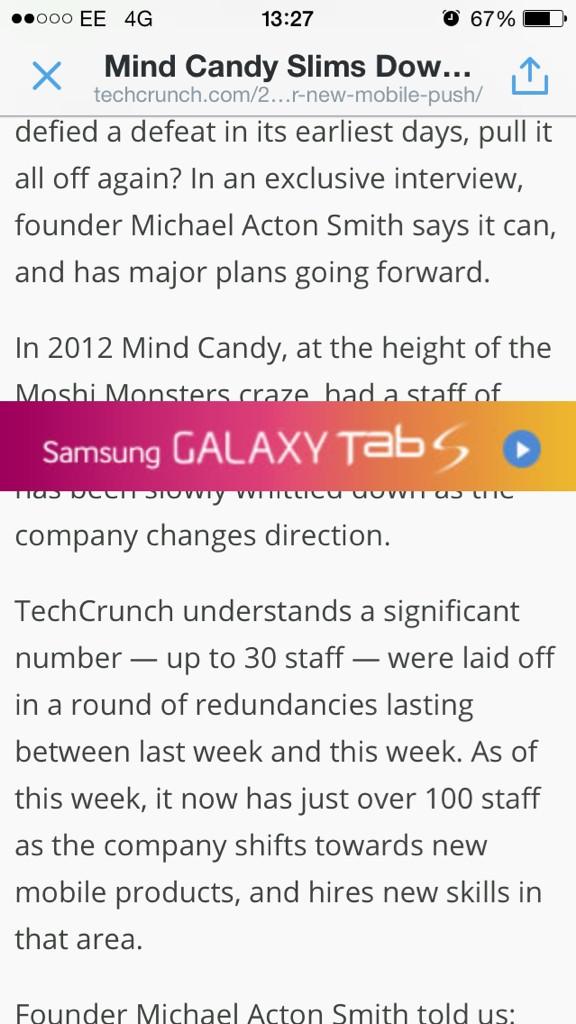
Do you see yourself as a digital creator? Or more of a consumer? Most people will find themselves on a continuum, sometimes creating, now consuming. At times, the consumption of content - be it text, video, static image or audio - will directly prompt creativity. This 'moment of intersection', as we defined it, occurs when the consuming of content engenders creativity. It is not the inspiration itself - the instance of 'aha!' - but rather the decision to act upon it.
In the interests of prompting a conversation, we developed a rough user interface concept to show how a moment of intersection between consumption and creativity might be enhanced. What do you think of the storyboard above (you can click on it for the full-size version)?
The work was grounded in 3 rules:
Do you see yourself as a digital creator? Or more of a consumer? Most people will find themselves on a continuum, sometimes creating, now consuming. At times, the consumption of content - be it text, video, static image or audio - will directly prompt creativity. This 'moment of intersection', as we defined it, occurs when the consuming of content engenders creativity. It is not the inspiration itself - the instance of 'aha!' - but rather the decision to act upon it.
The intersection is the fulcrum about which the individual pivots from consumer to creator, and allows for - and enables - the return to consumption.In discussion, we noticed how little had been said about the user experience of this intersection. Both 'Create' and 'Consume' have been individual themes at MEX but we wanted to go further and investigate the relationship between them. The motivations and the states of mind inherent in media consumption have been thoroughly explored, both at MEX and in other fora. At the March 2014 MEX, Alex facilitated a group to investigate user experience design principles to maintain focus during the consuming of digital media. A by-product of that exercise invoked some interesting modes of consumption, where the purpose of consuming was specifically to prepare for creating. While it remained tacit, the existence of the intersection was implicit: whether it leads to inspiration or is informed by it, media consumption will frequently result in various forms of creativity. Not quite as much is said, outside the worlds of art and of creative enterprises, about the creativity and the range of forms that it takes when 'ordinary' individuals turn their minds to producing new works. Nevertheless, it seems relatively well understood. Perhaps where there is a need for greater discussion is at the intersection - the transition zone - between the consumption of content and the subsequent creation of new forms. While the technological potential of mobile devices such as smartphones, tablets and wearables advances rapidly, their interaction models continue to favour passive consumption at the expense of nurturing users' creative impulses.
We believe that the creative customer segment has been underserved, giving rise to an opportunity for media owners, device manufacturers, platform providers and software developers to win new users by improving the experience of transitioning between modes of consumption and creativity. In all cases, there is almost certainly sufficient capability to enable more frequent and more deliberate acts of creativity in response to consumed content.Except in the most trivial cases, the moment of intersection is often poorly handled by app designers. In our view, even the act of sharing media is a form of creativity, however simplistic that might appear. The retweet, therefore, could be considered the most transient and low-input form of creativity that exists in digital media today. If we consider the evolution of retweeting as an action over time, we find this function of Twitter has improved the user experience around an important example of intersection. A more immersive journey might transport a user from a social media item (such as a pin, post, tweet or status update), via a web link, to a piece of content, which might itself sit within a dedicated app. The viewer, whose attention has been grasped on the social media platform, might wish to respond to the content in a more creative way than simply tapping a retweet 'button'. For example, a reader of a blog post might wish to comment; a viewer of video might produce a visual response; a music listener might create a playlist. Two points are worth noting:
- None of these seem examples seem like excessively strenuous activities, yet people who attempt them frequently will know that the user experience as it stands today can be convoluted and poorly designed.
- These methods of response have come into existence only in the past few years and some more traditional media companies have not have fully realised the myriad ways in which this creative loop could influence their content.
- User relevance. Addressing a common task already familiar to users rather than trying to project too far into the future. We chose the act of extracting and adding context to an image embedded in a news article.
- Technical viability. Referencing techniques available today, or in the near future, across a range of platforms. In this case, we took particular inspiration from the introduction of multi-window features in iOS 9, Windows 10 and future versions of Android.
- Fluidity. The transition from consumption to creativity should be seamless. We try to show how a single touchscreen gesture can initiate and enrich the moment of intersection, thereby kickstarting the creative process.
- Which aspects do you find painful in your own experience of switching between consuming and creative digital media?
- How do you go about moving back and forth between the states of consuming and creating?
- What apps, tools and behaviours have you observed in other users?
Labels:
consume,
create,
digital media,
Intersection,
MEX,
UX
Tuesday, 19 May 2015
Is ad blocking immoral?
The FT reported last week that mobile operators plan to block online ads, with one - unnamed - European operator planning to switch on adblocking before the end of 2015. Given that the software it will use was developed by Shine, an Israeli company back by Li Ka-shing's Horizon Ventures, it would be unsurprising if it turned out to be the operator 3.
Martin Bryant, editor of The Next Web, responded stating "Adblockers are immoral... proud ad-blocking folk out there are happily starving sites (that they rely on for information and entertainment) of vital income." How can anyone argue with the need to compensate those who provide us with the information - and other content - we consume?
And yet...
When my reading of an article is so severely impeded by advertising, I find myself with two choices, either I stop reading that content or I block ads. That example, from nearly a year ago, is relatively innocuous compared with some of the more recent display formats. So my question for publishers is: do you want to lose revenue because your readers can't abide the awful experience and walk away; or because they block your ads?
I mostly consume text media on my phone and I don't run an adblocker on it. Instead, when I find a publisher repeatedly using overly intrusive advertising, I stop reading, unfollow them on Twitter and permanently abandon them. That means publishers with better user experience policies get more attention from me. Am I the only one who does this?
As Martin Bryant says, advertising fuels much of the web. Much of the work I have done in the past ten years has relied largely on advertising revenue. Yet the "give-and-take" of which he speaks too often is not correctly set. Ads should at most feel like passing through security but sometimes feel like a trip to the back room and an unwarranted cavity search.
Readers should not block ads; ads should not block readers.
The Next Web has apparently been working on developing 'ads so good you want to share them'. Says Martin Bryant:
We’re still perfecting the format, but I’m proud that the company I work for is trying to create ads that people won’t want to block in the first place.As I said last week, user experience is a source of competitive advantage.
Labels:
ad blocking,
advertising,
Hutchison Whampoa,
Martin Bryant,
Online advertising,
TNW,
UX
Wednesday, 13 May 2015
Experience as the competitive advantage
User experience, customer experience... these mean different things in business but for the consumer - the individual, the person - who encounters a business, it's all just the experience of dealing with your company.
I received an email today from the Cheap Energy Club, part of Martin Lewis' Money Saving Expert. This is how it started:
About 7 seconds later, I was looking at a list of energy companies and the amount I would save, compared with what I pay today, as well as other bits of information.
Crucially, it also told me what other Cheap Energy Club members were saying about aspects of their experience when it fell outside the norm, either good or bad; or if the provider had too few customers for a reliable reading.
There is a good piece by Seth Godin today about becoming unsubstitutable. Put simply, if there's no discernible difference between what you and someone else is offering, the customer will opt for the cheaper. However, when you're in the business of providing a commodity like gas or electricity, you can only compete on price up to the point where you aren't providing a worthwhile return on investment. So the trick is to differentiate, to stop being a commodity. I switched to Ovo Energy a year ago, when I moved home, not only because it was cheaper than the alternatives but because consumers rated the experience highly.
Today, as I looked down the list of cheaper alternatives, the decision was easy. I was not prepared to give up the excellent experience of buying energy from Ovo in return for a cheaper price. Effectively, I'm prepared to pay something like 10-15% more for it, so that I don't have to deal with the problems of other utilities:
I received an email today from the Cheap Energy Club, part of Martin Lewis' Money Saving Expert. This is how it started:
You asked us to tell you when you’re paying too much on your energy bills
So here goes: “YOU’RE NOW PAYING TOO MUCH!”
About 7 seconds later, I was looking at a list of energy companies and the amount I would save, compared with what I pay today, as well as other bits of information.
Crucially, it also told me what other Cheap Energy Club members were saying about aspects of their experience when it fell outside the norm, either good or bad; or if the provider had too few customers for a reliable reading.
There is a good piece by Seth Godin today about becoming unsubstitutable. Put simply, if there's no discernible difference between what you and someone else is offering, the customer will opt for the cheaper. However, when you're in the business of providing a commodity like gas or electricity, you can only compete on price up to the point where you aren't providing a worthwhile return on investment. So the trick is to differentiate, to stop being a commodity. I switched to Ovo Energy a year ago, when I moved home, not only because it was cheaper than the alternatives but because consumers rated the experience highly.
Today, as I looked down the list of cheaper alternatives, the decision was easy. I was not prepared to give up the excellent experience of buying energy from Ovo in return for a cheaper price. Effectively, I'm prepared to pay something like 10-15% more for it, so that I don't have to deal with the problems of other utilities:
- "in recent months our users have reported major issues with its switching process and customer service."
- "difficulties contacting by phone or email and in some cases it has not completed requested switches"
Wednesday, 6 May 2015
The EC Digital Single Market Strategy and the British Television Industry
Today, the European Commission published its strategy on the Digital Single Market. As was to be expected, there was both abundant support and vehement opposition to the idea.
As I scrolled through Twitter looking for reactions I came across these two items:
However, the Digital Single Market could benefit the BBC - and deliver further revenue, so that the iPlayer is, in fact, subsidised by EU viewers outside the UK. Today, in the UK, watching the iPlayer is free of advertisements. There is nothing in the EC strategy document that suggests that for other EU viewers, the BBC couldn't generate revenue from ad placements. Meanwhile, clearly UK citizens will benefit from access to content from other EU countries.
The objectives ('Pillars') of the Digital Single Market strategy are:
The strategy contains 16 initiatives. For the TV industry, there are two that are particularly relevant. The Audiovisual Media Services Directive underpins much of the law concerning linear broadcast and on-demand streaming. The Commission will consider how to adapt the rules to new business models for content distribution. The Satellite and Cable Directive will also be reviewed to consider the inclusion of broadcasters' online transmissions within its scope.
It seems highly likely that the Digital Single Market strategy will force the TV industry to change the way rights are bought and sold across the European Union. The implications are not trivial. For instance, the rights to sporting events, which are sold on a country-by-country basis will have to change, if viewers across Europe can access television broadcasts from anywhere within the EU. The cross-border portability of copyright-protected content services is a stated aim of the strategy, as well as to boost cross-border access to broadcasters' services in Europe.
So, if we are to have in the UK an 'in-out' referendum on EU membership in 2017, will the Digital Single Market strategy encourage the British people to stay or go?
As I scrolled through Twitter looking for reactions I came across these two items:
EU digital single market geo-lock clampdown could spark @BBCiPlayer funding issue http://t.co/xYy9R2fjec pic.twitter.com/a6nILRudkJ
— The Drum (@TheDrum) May 6, 2015
iPlayer on your holidays? EC looks to make it possible: The European Comission wants to make it possible... http://t.co/ayprxEEicF #IPTV
— TV Connect Event (@tvconnectevent) May 6, 2015
The European Commission absolutely believes that content available online in one EU country should be available in all. The first article, with commentary from a leading law firm, implies that it would be unfair for UK licence fee payers to subsidise access to the BBC iPlayer for other EU citizens. The second states that the BBC supports the strategy and is beginning work on how to implement it.However, the Digital Single Market could benefit the BBC - and deliver further revenue, so that the iPlayer is, in fact, subsidised by EU viewers outside the UK. Today, in the UK, watching the iPlayer is free of advertisements. There is nothing in the EC strategy document that suggests that for other EU viewers, the BBC couldn't generate revenue from ad placements. Meanwhile, clearly UK citizens will benefit from access to content from other EU countries.
The objectives ('Pillars') of the Digital Single Market strategy are:
- Better access for consumers and businesses to digital goods and services across Europe.
- Creating the right conditions and a level playing field for digital networks and innovative services to flourish.
- Maximising the growth potential of the digital economy.
The strategy contains 16 initiatives. For the TV industry, there are two that are particularly relevant. The Audiovisual Media Services Directive underpins much of the law concerning linear broadcast and on-demand streaming. The Commission will consider how to adapt the rules to new business models for content distribution. The Satellite and Cable Directive will also be reviewed to consider the inclusion of broadcasters' online transmissions within its scope.
It seems highly likely that the Digital Single Market strategy will force the TV industry to change the way rights are bought and sold across the European Union. The implications are not trivial. For instance, the rights to sporting events, which are sold on a country-by-country basis will have to change, if viewers across Europe can access television broadcasts from anywhere within the EU. The cross-border portability of copyright-protected content services is a stated aim of the strategy, as well as to boost cross-border access to broadcasters' services in Europe.
So, if we are to have in the UK an 'in-out' referendum on EU membership in 2017, will the Digital Single Market strategy encourage the British people to stay or go?
Labels:
BBC,
digital media,
Digital Single Market,
European Commission,
online TV,
TV,
VOD
Subscribe to:
Posts (Atom)