Pages

Showing posts with label advertising. Show all posts

Tuesday, 19 May 2015

Is ad blocking immoral?

The FT reported last week that mobile operators plan to block online ads, with one - unnamed - European operator planning to switch on adblocking before the end of 2015. Given that the software it will use was developed by Shine, an Israeli company back by Li Ka-shing's Horizon Ventures, it would be unsurprising if it turned out to be the operator 3.

Martin Bryant, editor of The Next Web, responded stating "Adblockers are immoral... proud ad-blocking folk out there are happily starving sites (that they rely on for information and entertainment) of vital income." How can anyone argue with the need to compensate those who provide us with the information - and other content - we consume?

And yet...
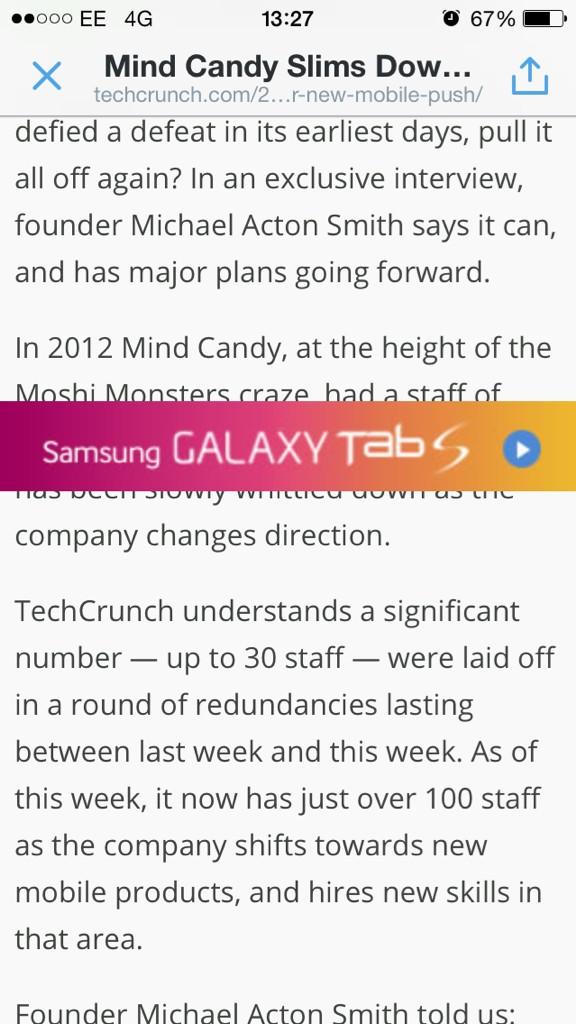
When my reading of an article is so severely impeded by advertising, I find myself with two choices, either I stop reading that content or I block ads. That example, from nearly a year ago, is relatively innocuous compared with some of the more recent display formats. So my question for publishers is: do you want to lose revenue because your readers can't abide the awful experience and walk away; or because they block your ads?

I mostly consume text media on my phone and I don't run an adblocker on it. Instead, when I find a publisher repeatedly using overly intrusive advertising, I stop reading, unfollow them on Twitter and permanently abandon them. That means publishers with better user experience policies get more attention from me. Am I the only one who does this?

As Martin Bryant says, advertising fuels much of the web. Much of the work I have done in the past ten years has relied largely on advertising revenue. Yet the "give-and-take" of which he speaks too often is not correctly set. Ads should at most feel like passing through security but sometimes feel like a trip to the back room and an unwarranted cavity search.

Readers should not block ads; ads should not block readers.

The Next Web has apparently been working on developing 'ads so good you want to share them'. Says Martin Bryant:
We’re still perfecting the format, but I’m proud that the company I work for is trying to create ads that people won’t want to block in the first place.
As I said last week, user experience is a source of competitive advantage.

Thursday, 30 July 2009

Sky earnings undermine ad-funded online TV


We can talk and talk and talk about online TV, Hulu, YouTube, BBC iPlayer and Zattoo. BSkyB, meanwhile, has picked up nearly half a million (net new) subscribers in the last year. There are now 9.4m Sky customers. Paying customers.

Sky takes £464 from each customer per year. If Sky operated an advertising model, to hit the same level of earnings per customer, the numbers would have to look like this:
CPM: £20
Impressions per viewer per year: 23,200
Impressions per viewer per day: 64
A CPM of £20 is achievable for video pre-roll but high and difficult to sustain as an average for all the available advertising inventory. Consider then that at a CPM of £20, you'd need 64 impressions per day per viewer. Most ad campaigns are capped in terms of number of impressions per day per viewer, often at around two.

So you'd need 32 advertising campaigns running the whole time with viewers glued to their screens 24/7, changing channel nearly three times per hour, every hour of the day. That's how to make £464 per customer from ad-funded online TV.

Sure, YouTube has so many more users. But BSkyB is making £5.4bn with an operating profit of £813m.

Sky doesn't bother to report how well it's online VOD service is doing. It's just not significant.

I'm not writing off online TV. On the contrary, one day, I believe, most TV will be delivered over the Internet (although satellite technology is pretty damned awesome). It's just that, right now, things aren't quite in place for it to really take-off. Broadband speeds need to increase. PC processing power needs to improve. Content rights need to be sorted. And a viable business model is needed.

For all the talk of online video, in the UK, we still watch nearly four hours a day each on the old TV set. That's where the viewers are and that's where the money is. Today.


Wednesday, 15 July 2009

Bing - fewer ads means more kerching!


Bing has reduced the number of ads it shows on its first page of results, apparently in an attempt to increase relevance to keyword.

AdGooroo has counted the average number of ads per keyword for Google, Yahoo! and Bing. While the other two are showing five to six ads, Bing is down to three and has markedly more relevant results. Revolution says:
AdGooroo conducted a number of tests on keywords including ‘Hawaii' on all three search engines. Google and Yahoo! returned results that were ‘rather far afield', while Bing delivered three ‘highly relevant' ads for Hawaii helicopter tours, Hawaii holiday rentals and Hawaiian tour packages.
That the relevance to keyword is greater is no doubt the message that Microsoft wants advertisers to hear about Bing.

This is slightly disingenuous reporting. First, the decline occurred before the rebranding, around October/November 08. Second, if you look at the US & International picture (not just US), Microsoft reduced its ads/keyword to the same level as Yahoo! just at the time when Google significantly increased its number, having been at the same level as Yahoo!. The global picture now is Google 5+ ads/keyword with Yahoo! and Microsoft tracking around 4.

Nevertheless, it reveals two distinct strategies. Google's is to squeeze extra ads on to its 'real estate'. With its huge market share of search, increasing ads/keyword increases revenue.

Microsoft, on the other hand, by reducing supply of ad space on the first page of results, can charge a higher price for the ads. Then, by rebranding, making some valuable albeit relatively straightforward changes, spending lots of money on marketing etc, it increases its share of search and by so doing, increases the value of the first page results to advertisers, increases the number of clicks and also increases the cost per click.


Friday, 20 February 2009

Surfers become suckers at six

click
Online advertising works best after 6pm, according to new research carried out for the IAB, 'Receptivity of the online audience'.

Consumers were asked to rate how likely they think they are to pay attention to online ads when carrying out a range of activities online. According to respondents, the best time to reach them with ads is during e-commerce activity, whether researching the best deals or shopping online.

The research also suggests that social networking has a high level of receptivity. I'm not sure what this means. If it's suggesting that people click on Facebook ads, it flies in the face of experience.

Try a Google search on 'facebook ad performance'. There's not a lot of positive comment. One social media reviewer even says "Facebook Ad Click-Through Rates Are Really Pitiful". It's from April 2008, so maybe everything has changed now. I just can't find anything that contradicts it.

Some might contend that it's naive just to look at click-through rates. I'd agree it's not the only metric to consider. But it's not a bad starting point for measuring engagement across different sites, at various times of the day, for any given demographic.

Wednesday, 31 December 2008

Scent of a lemon

While enjoying my very lemony shower gel this morning, I got thinking about the old "you know when you've been Tango'd" ads. Like this one...


So being a film fan - and believing that watching film at the cinema is the full flavoured experience - I came up with the germ of an idea for a series of ads for Tango to be shown on the silver screen. Here's the first in the series, for lemon tango.

'Scent of a Lemon'

It's the run-up to the tango scene in Scent of a Woman. Smart restaurant, milongas playing in the background. Lt Col Frank Slade (Al Pacino) and Charlie Simms (Chris O'Donnell) have just sat down at the table where Donna (Gabrielle Anwar) is waiting for her lunch date...

Lt Col Frank Slade:
I dedect a fragrance in the air. Don't tell me what it is... it's citrus limon.
Donna: That's amazing.
Lt Col Frank Slade: Well, I'm in the amazing business.
Donna: It is citrus limon. My grandmother squeezed it this morning.
Lt Col Frank Slade: I'm crazy about your grandmother... so, Donna, d'you Tango?
Donna: I've never tried
Lt Col Frank Slade: well, Donna, I'm offering my services.

He offers his hand to her but a bright yellow lemon Tango dancer screams into view, pulls him onto the dance floor and tangos him to within an inch of his life.

Voiceover: You know when you've been Tango'd.
Lt Col Frank Slade: Woo-hah!


Tango is under threat. Visit http://www.savetango.co.uk/

Thursday, 13 November 2008

Online video - there is jam tomorrow

Erick Schonfeld on TechCrunch has just painted a stark picture of the future of online video. Looking at the recent announcement from YouTube about running Google AdWord style ads, as well as stories of layoffs at start-ups, he throws out the projections by emarketer that online video advertising will be worth $5bn in 5 years.

The main thrust of the argument is that there is already tons of online video that isn't succeeding in attracting ads and compares a $0.05 CPM for online video with $0.50 for broadcast TV. So the only way is down.

Not at all.

At the Web 2.0 Summit, just a week ago, Morgan Stanley's internet analyst, Mary Meeker, presented her future of the world, also covered by Schonfeld.

Focussing on the US (not, after all, the world), she says: the economic outlook is bad; online ad impressions are growing very fast; the two things combined mean online ad spend growth is slowing down hard; but there's still plenty of upside since so much is still spent on, for example, newspaper ads.

Lets be clear about the upside. In the UK, online ad spend is already almost as much as for TV. According to the Internet Advertising Bureau, the former accounts for 18.7% of the total £9bn spent on ads, compared with 21.7% for TV and 19.3% for print.

The forecast for next year from research firm Research and Markets is for growth of 31.4%, while the consensus for TV advertising is of a decline of around 10%. In short, online ad spend will overtake TV ad spend.

While online ad spend covers everything from paid search to online video, it's clear that, in some ways, the US ad market has not innovated in the way that the UK has. Surprising as that is to me, the US online ad market is likely to grow enormously in proportion to other categories over the coming years.

Indeed, in a downturn, this can only accelerate, as companies look for measurable returns, hard to get from broadcast TV.

The other part of the equation, which Schonfeld finesses, is the relative value of professional versus user-generated content. The proportion of the former is very small and growing fast and with it comes an increase in CPMs.

Schonfeld's pie charts indicate, on the contrary, that the value of online advertising is set to increase dramatically. The tiny proportion of TV that is accounted for by online video is tiny. That will change.

Indeed, if the projections are accurate for the growth of online video and VOD, and CPMs get to only half of what TV broadcasting achieves, then the $5bn mark will be achieved.

Friday, 31 October 2008

Connect online/offline [Updated 19 Jan 2010]

The guardian today publishes an interview with Francesco D'Orazio, founder of Myrl, a start-up setting out to build bridges between virtual worlds. There seems to be a desire to enable people to link up their disparate networks and access them in one smorgasbord of social media sites. Personally, I don't see the point. I use my networks in different ways and for specific purposes. I'm quite happy - indeed, keen - to keep them separate. Update 19 Jan 2010: myrl.com does not respond

A classmate from business school, on the other hand, has come up with a different approach to linking people online. The Poken is a clever little device that enables you to share your details with other poken-ites by tapping poken to poken. The devices then instantly swap information. When you get home you just plug the USB device into your laptop and Fred is your Facebook Friend.

Meanwhile, I read earlier this week that Nuts TV is coming off Freeview and is going to be broadband only. The move, to me, marks a significant transition towards the broadcasting of television over the internet - whether or not you receive it on your TV or PC screen. Fundamentally, as well as making the content easy to access for its young, male audience, going online makes the advertising proposition much more attractive for advertisers.

Along with many others, ITV and WPP are saying 2009 is going to be a tough year for TV advertising. Until there is a complete shift in thinking about the broadcasting of TV, advertisers will continue to reduce their investments in the public service broadcasters in favour of more measurable media.

Yes, people were saying the same thing at the dawn of the Internet age, all of 10 or so years ago. It's only recently, however, that society has embraced the web as a central hub for entertainment. At the same time, the technology to stream video and the broadband capacity have improved to the point where it is now viable. The future of TV is over IP.